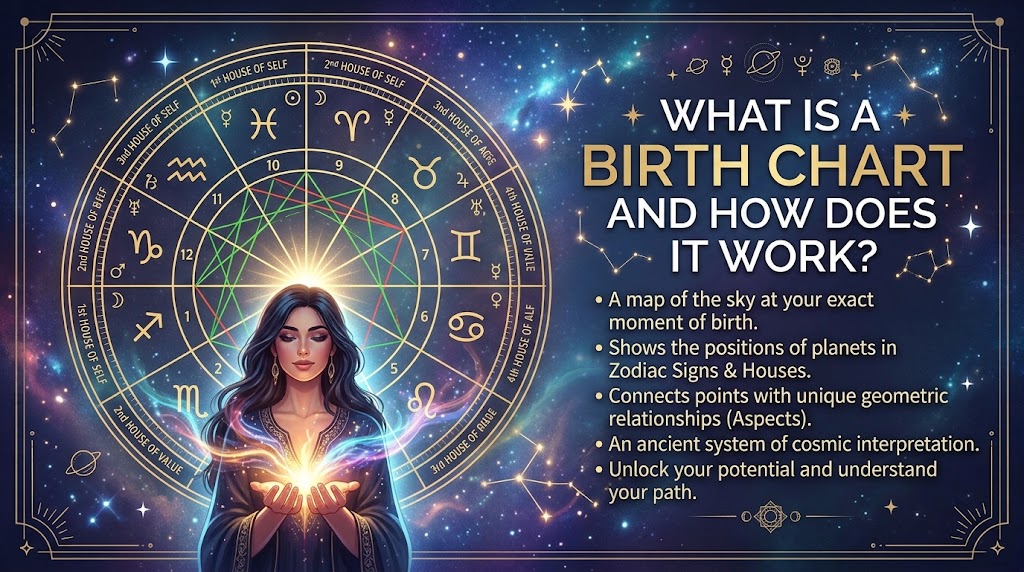
A birth chart is one of the most important tools used in astrology to study the planetary positions at the time and place of a person’s birth. It is often described as a snapshot of the sky at a particular moment. Astrologers use this chart to interpret different areas of life, including personality, relationships, career interests, emotional patterns, and important life themes.
Unlike a general horoscope based only on a person’s zodiac sign, a birth chart contains much more information. It considers the date, exact time, and location of birth to create a more detailed astrological profile.
What Information Is Needed for a Birth Chart?
Creating a birth chart normally requires three important details: date of birth, time of birth, and place of birth.
The date helps determine the positions of the Sun and other planets. The exact birth time is particularly important because it helps calculate the Ascendant, also known as the rising sign. The birthplace is used to calculate the geographical position of the chart and the division of the twelve houses.
Even a small difference in birth time can sometimes change the Ascendant or house positions, which is why astrologers generally prefer an accurate birth time when preparing a detailed chart.
The Main Parts of a Birth Chart
A birth chart contains several elements that work together. The twelve zodiac signs provide the symbolic background, while the planets represent different areas of human experience.
The Sun is commonly associated with identity, confidence, and personal expression. The Moon is traditionally connected with emotions, habits, and inner responses. Mercury is associated with communication and thinking, while Venus relates to relationships, attraction, and preferences. Mars is commonly linked with action, energy, and determination.
Jupiter, Saturn, Uranus, Neptune, and Pluto are also considered in many modern astrological systems. Their positions and relationships with other planets can add further layers to an astrological interpretation.
What Are the Twelve Houses?
One of the most useful features of a birth chart is its twelve-house system. Each house represents a different area of life.
The first house is associated with personal identity and outward expression. The second is traditionally connected with possessions and personal values. Other houses cover subjects such as communication, family, creativity, work, partnerships, shared resources, beliefs, career, friendships, and long-term goals.
The meaning of a planet can therefore change depending on which house it occupies.
For example, an astrologer may interpret Venus differently when it appears in a relationship-oriented house compared with a career-related house. This is one reason why reading only a zodiac sign does not provide the complete picture of a birth chart.
Understanding the Ascendant
The Ascendant, or rising sign, is the zodiac sign appearing on the eastern horizon at the time of birth. It is an important part of a natal chart and is traditionally associated with appearance, first impressions, personal approach, and the way an individual interacts with the outside world.
The Ascendant also establishes the starting point for the twelve houses in many house systems. Because it depends heavily on birth time and location, accurate birth information can be particularly important when calculating it.
What Are Planetary Aspects?
A birth chart is not simply a list of planets and zodiac signs. Astrologers also examine the angular relationships between planets, known as aspects.
Common aspects include conjunctions, oppositions, trines, squares, and sextiles. Each aspect is traditionally given a different interpretation.
For instance, a conjunction occurs when planets are positioned close together and their symbolic meanings are considered together. An opposition places planets across from one another in the chart, while a square represents another type of significant angular relationship.
Astrologers combine these aspects with signs and houses to develop a broader interpretation.
How Does a Birth Chart Work in Astrology?
The basic process begins with calculating the planetary positions for the person’s birth date, time, and location. These positions are then placed into a circular chart divided into zodiac signs and houses.
An astrologer studies the relationships between these elements and interprets recurring themes within the chart. The interpretation may focus on personality traits, emotional tendencies, relationships, career interests, personal challenges, and areas of potential development.
Astrology is an interpretive tradition rather than a scientifically established method for predicting events. Therefore, birth-chart readings are best understood as an astrological framework for reflection and interpretation rather than a scientifically proven assessment.
Why Is Accurate Birth Time Important?
Birth time can make a significant difference in a detailed chart because the Ascendant and house placements are calculated using time and location.
When someone does not know their exact birth time, an astrologer may use alternative approaches, depending on the astrological tradition being followed. However, a chart created with an approximate time may produce different house or rising-sign results.
For this reason, people seeking a detailed birth-chart reading should provide the most accurate birth information available.
Birth Chart and Personal Consultation
A birth chart can contain a large amount of information, but understanding it requires looking at the chart as a complete system rather than focusing on one planet or zodiac sign.
A professional astrology consultation may examine the Ascendant, planetary placements, houses, aspects, and other traditional techniques together. This can provide a more personalized interpretation than reading a general daily or monthly horoscope.
For people interested in understanding their birth chart, a personalized consultation can also help explain unfamiliar astrological terms and how different parts of the chart relate to one another.
Final Thoughts
A birth chart is essentially a detailed astrological map calculated from the sky at the time and place of birth. It includes zodiac signs, planets, houses, the Ascendant, and planetary aspects.
While astrology does not have scientific evidence establishing birth charts as a predictive or diagnostic system, many people use astrology as a traditional framework for self-reflection and exploring personal themes.
Understanding how the different components of a birth chart fit together can make astrology easier to explore and can provide a more complete perspective than relying on a single zodiac sign.